
Professional or Freelancer in Florida 2026?
Working as a self‑employed professional or freelancer in Florida gives you freedom, flexibility, and control over your income. But it also comes with a major responsibility: managing your own taxes without an employer handling them for you.
This guide breaks down everything you need to know—forms, deductions, quarterly payments, common mistakes, and how to stay compliant with the IRS while maximizing your financial benefits.
🧭 1. What “Self‑Employed” Means for the IRS
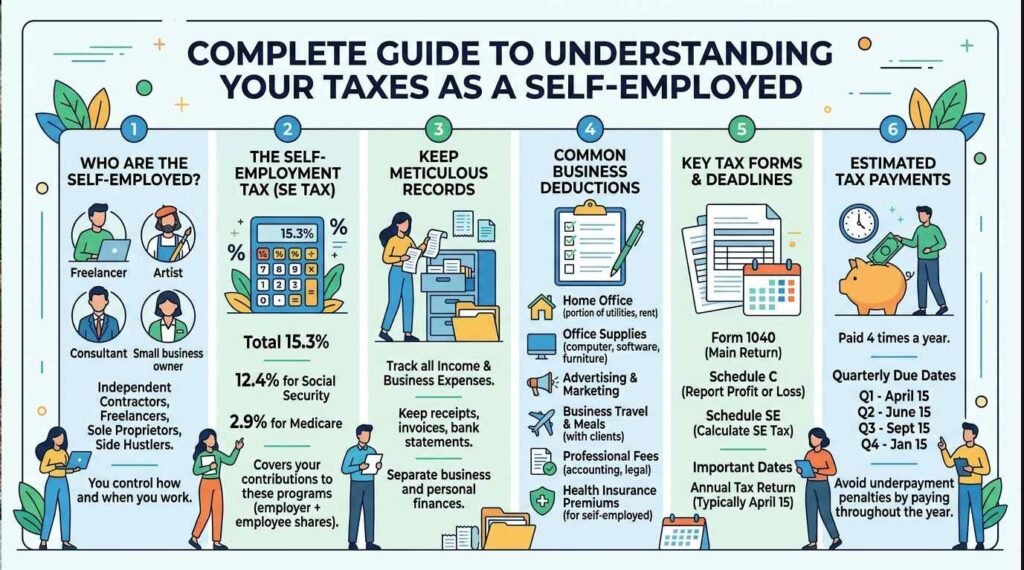
The IRS considers you self‑employed if you:
- Work independently and do not receive a W‑2
- Receive 1099‑NEC or 1099‑K forms
- Provide services as a freelancer, contractor, consultant, creator, gig worker, or digital entrepreneur
- Operate your own small business or sole proprietorship
If you fall into any of these categories, you are responsible for reporting your income, paying your taxes, and covering your own Social Security and Medicare contributions.
📄 2. Essential Tax Forms for Freelancers in Florida
1099‑NEC
Issued when a client pays you $600 or more during the year.
1099‑K
Issued by payment platforms like PayPal, Stripe, Uber, DoorDash, Etsy, or Cash App when you exceed federal reporting thresholds.
Schedule C (Form 1040)
Where you report your business income and expenses. This is the core tax form for freelancers.
Schedule SE
Calculates your Self‑Employment Tax, which covers Social Security and Medicare.
💰 3. How Much You Pay in Taxes as a Self‑Employed Worker
You pay two main types of taxes:
1. Federal Income Tax
Based on your net profit after deductions.
2. Self‑Employment Tax
Currently 15.3% of your net earnings:
- 12.4% for Social Security
- 2.9% for Medicare
Good news: Florida has no state income tax, which simplifies your tax burden.
📆 4. Do You Need to Pay Quarterly Taxes?
Most freelancers do. You must make estimated quarterly payments if you expect to owe more than $1,000 in taxes for the year.
Quarterly deadlines:
- April
- June
- September
- January
Paying quarterly helps you avoid penalties and keeps your IRS account in good standing.
🧾 5. Key Tax Deductions for Freelancers in Florida
Deductions reduce your taxable income and can save you thousands. Common deductible expenses include:
- Home office
- Internet and phone service
- Software, apps, and digital tools
- Computers, cameras, and equipment
- Vehicle mileage for business use
- Marketing and advertising
- Professional services (accounting, legal, consulting)
- Education, courses, certifications
- Subscriptions and online platforms
Every deduction must be ordinary, necessary, and properly documented.
📚 6. How to Organize Your Income and Expenses
A simple system can keep your finances clean and audit‑ready:
- Use a separate business bank account
- Digitally store receipts and invoices
- Track income weekly
- Use accounting apps like QuickBooks, Wave, or FreshBooks
- Work with a tax professional to avoid costly mistakes
⚠️ 7. Common Mistakes Freelancers Should Avoid
Avoid these frequent errors:
- Not reporting small or irregular income
- Mixing personal and business expenses
- Forgetting quarterly tax payments
- Failing to keep receipts
- Ignoring IRS letters
- Waiting until the last minute to file
These mistakes can lead to penalties, interest charges, or IRS audits.
🛡️ 8. What to Do If You Receive an IRS Letter
Stay calm—most IRS notices are simple:
- Income verification
- Minor adjustments
- Requests for documentation
- Payment reminders
A tax professional can review the letter, respond correctly, and prevent the issue from escalating.
📍 9. Why Working With a Florida Tax Professional Matters
Florida has unique tax advantages and specific rules for:
- Self‑employment
- LLCs
- Digital income
- Gig‑economy workers
- 1099‑K reporting changes
A professional can help you:
- Legally reduce your tax burden
- Avoid IRS penalties
- Organize your finances
- Plan for long‑term growth
- Understand deductions you may be missing
🎯 Conclusion
Being self‑employed in Florida is an incredible opportunity—but it requires smart tax management. With the right guidance, you can:
- Pay less in taxes
- Avoid penalties
- Stay compliant
- Build a stronger financial future
