
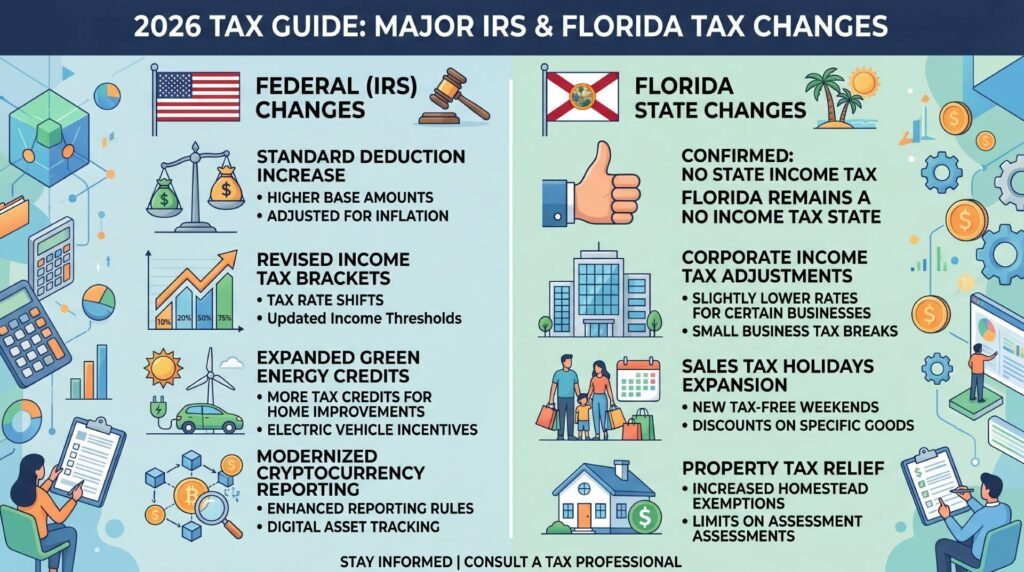
2026 Tax Guide: Crucial IRS Updates and Florida’s Major Digital Shift You Can’t Ignore
The tax landscape is shifting rapidly this year. Consequently, you must adapt quickly whether you are a small business owner in Miami or an individual filer. There are critical new rules at both the federal and state levels. Specifically, the IRS and the Florida Department of Revenue (FDOR) have rolled out major changes.
At The Taxman 59, we have broken down the most important updates. Therefore, you won’t be caught off guard and can plan your financial strategy with complete confidence.
1. IRS Updates: Higher Deductions and New Family Benefits
At the federal level, inflation and recent tax legislation have brought significant changes. As a result, these adjustments will directly impact your wallet.
-
Higher Standard Deductions: For the current tax year, the standard deduction rises to $16,100 for single filers. Similarly, it increases to $32,200 for married couples filing jointly. This means a larger portion of your income is entirely tax-free.
-
The Definite End of Paper Refund Checks: Following federal modernization mandates, the IRS is actively phasing out physical paper checks. Consequently, setting up direct deposit with your routing and account numbers is no longer optional. You must use direct deposit if you want your money quickly and securely.
-
Expanded Tax Relief: Furthermore, the IRS has rolled out new online portals to monitor expanded family credits. This includes the Child and Dependent Care Credit. In addition, new special deductions apply to specific overtime or tip income under current guidelines.
2. Florida Alert: The Department of Revenue Is Going 100% Digital
If you run a business in the Sunshine State, this next update is absolutely critical. Indeed, you need to pay close attention to it right now.
The Florida Department of Revenue (FDOR) is finalizing its complete migration to a new platform. Specifically, they are moving to the unified eServices File and Pay system. This shift completely changes how you report and pay state taxes:
-
Goodbye to Old Portals: The traditional portal for filing Sales Tax is being decommissioned permanently. Instead, the mandatory new access point is
[floridarevenue.com/taxes/filepay](https://floridarevenue.com/taxes/filepay). -
Reemployment Tax Relocation: In addition, the mandatory transition for reporting employee unemployment taxes (Form RT-6) takes effect on August 1, 2026.
-
Crucial Historical Data Warning: However, you must be careful because past filing histories will not automatically transfer to the new digital system. If you haven’t downloaded your previous records, you will need professional accounting support. Otherwise, you cannot easily verify past balances during an audit.
3. What’s Cooking: Sales Tax Relief and “Home Hardening”
To provide relief to the local economy, the Florida legislature has maintained key incentives. For example, they are focusing heavily on the cost of living and property protection:
-
“Home Hardening” Tax Credit: First, sales tax exemptions remain active for home protection products. These include impact-resistant windows and doors for primary residential properties (Homestead) valued under $700,000.
-
High Interest Rates: Second, the state’s floating interest rate for unpaid or late state taxes remains high at 11% for the remainder of the year. Therefore, missing a deadline will become exceptionally costly.
The Taxman 59 Pro-Tip: Navigating Florida’s digital transition and the new IRS thresholds on your own can lead to delayed refunds. Alternatively, it can cause costly system penalties. At our Kendall office, we handle updating your business profile. Furthermore, we secure your direct deposits and maximize every legal deduction available.
