
Beyond the Ledger: Why Algorithmic AI and Automation Can’t Build Your Multi-Decade Wealth Strategy
Modern business owners live in an era of instant notifications and single-click automated answers. However, this environment creates a subtle but dangerous paradox. While data has never been more accessible, genuine financial wisdom has never been scarcer. Consequently, many entrepreneurs mistake a beautifully formatted, AI-generated spreadsheet for an actual long-term wealth strategy. Unfortunately, those spreadsheets only look backward. They guess blindly forward based on static mathematical algorithms. Most importantly, algorithms do not understand real human contexts, sudden economic shifts, or the intricate nuances of scaling a localized business into a legacy asset.
True financial mastery does not hide in off-the-shelf software models or automated responses. Instead, experts forge it through manual curation, rigorous data validation, and an unyielding commitment to organic, customized planning. For small businesses, corporate entities, and startups, a human-centric approach offers the only sustainable framework for generational wealth. This methodology maximizes compound interest while minimizing legal tax exposure.
The Failure of Automated Financial Frameworks
Currently, many business owners rely heavily on automated platforms to manage their basic accounting. While these software tools can easily categorize transactions, they consistently fail to answer the most critical question in wealth building: What does this data mean for your specific long-term future?
For example, an algorithm cannot analyze your business model to protect you from risk. It will not realize that your corporate structure exposes you to unnecessary state tax liabilities. Furthermore, automated systems cannot tell you when to aggressively reinvest capital back into your operations. They do not know when to capture capital gains or reallocate them into robust, long-term market indexes like the S&P 500. Without manual human intervention and seasoned oversight, automated advice strips away the context. As a result, this lack of human analysis leaves your business vulnerable to sudden regulatory changes, structural inefficiencies, and missed compound growth opportunities.
“A machine can process billions of data points in a second. However, it cannot sit across a desk from a business owner, analyze local market variables, and build an organic strategy based on 15+ years of real-world human experience.”
The Three Pillars of an Authoritative Wealth Strategy
Building an enduring financial strategy requires moving past daily transactional bookkeeping. To achieve this, you must integrate three distinct strategic pillars:
-
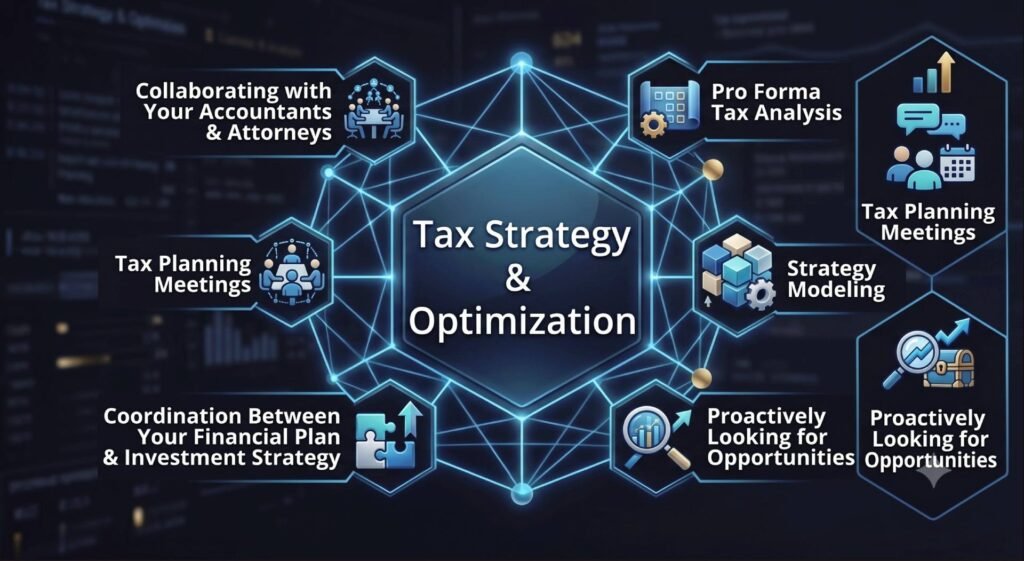
Proactive Structural Tax Planning: Waiting until the end of the fiscal year to analyze taxes is a major mistake. Instead, true strategic planning structures your corporate withdrawals dynamically. It requires you to manage depreciation assets manually. Ultimately, this process establishes legal tax mitigation parameters that keep capital inside your corporate environment where it can compound naturally.
-
Capital Allocation and Index Optimization: Sustained wealth accumulation relies on understanding compound interest both mathematically and practically. Therefore, by engineering consistent, deliberate cash-flow surpluses, business owners can establish structured corporate and personal contribution strategies. Reinvesting these funds into diversified equity indices sets up clear 10, 20, and 30-year growth trajectories that outpace inflation. Consequently, this protects your wealth against local economic volatility.
-
Rigorous Risk Mitigation and Cash-Flow Audits: Automated systems often overlook subtle patterns in capital drag, inventory synchronization delays, or hidden overhead inefficiencies. In contrast, manual, human-driven financial audits ensure that you optimize every single dollar within your corporate ecosystem for maximum efficiency.
Bridging the Local and the Global Macroeconomic Landscape
Every business operates within a unique micro-economy. At the same time, each company remains completely subject to global economic trends. For instance, a small business scaling within the high-growth corridors of South Florida faces unique regulatory pressures and operational overheads. These competitive dynamics differ vastly from a business operating out of New York or California. Therefore, generic financial advice simply cannot account for these hyper-localized realities.
Fortunately, an expert advisor seamlessly merges these local variables with macro-level wealth strategies. Perhaps you need to balance local supplier chains, or maybe you want to acquire real estate assets. Likewise, you might need to set up strict personal wealth buckets outside your corporate entity. In any case, your advisory must fit the exact location and jurisdiction where your business lives and breathes.
Secure Your Financial Legacy with The Taxman 59
Your business deserves more than synthetic formulas and generic automated advice. At The Taxman 59, recognized as the Winner of the Best of 2026 Miami (Zip Code 33193) in the Accountant Category by BusinessRate, we completely reject automated shortcuts. Instead, we believe in providing rigorous, manual curation of financial data, expert local insights, and deeply tailored wealth advisory services that help small businesses and startups thrive.
Let us manage the complexities of your corporate tax planning, risk management, and long-term financial strategies. Meanwhile, you can focus entirely on scaling your vision.
The Taxman 59 — Kendall Executive Center – contact us today!
-
📍 Address: 8785 SW 165 Ave., Suite 300, Miami, FL 33193
-
📞 Office: 305 392-0820 | 📱 Cell: 305 299-1537
-
✉️ Email: thetaxman59@yahoo.com
